Aconcagua - Part 1

Updated: Dec 2, 2017
December 2014, Argentina - At 22,841 feet, Cerro Aconcagua is the tallest mountain in the southern and western hemispheres. It crests the Andes mountain range in western Argentina, a giant wind scraped peak known for extreme weather conditions. As I’m writing this post, the weather forecast is calling for winds of 75 miles per hour on the summit with an effective windchill of -47 degrees Fahrenheit.
I knew the challenges that altitude and weather would play in my attempt of the peak, but those were distant thoughts as I de-boarded the LAN Airlines A320 on a hot day in December of 2014. Dirty and exhausted from over 20 hours of travel, I’d seemingly teleported into summer from a quite dreary winter solstice in Seattle. The gateway to Aconcagua is the small city of Mendoza and after months of planning and years of day-dreaming I had finally arrived.
"A nervous excitement permeated the air as this confederation of multi-national climbers mentally geared up for the challenge that lay ahead."
Most famous for it’s prolific Malbec production, a habit I’ve yet to shake, Mendoza sits on the eastern foothills of the Andes on the edge of a large arid plateau. With bags in hand and my shirt clinging to to my body there was no real indication of the extreme adventure that lay ahead. A short drive into the city revealed beautiful tree lined streets that reflected the relaxed nature of Argentines themselves.
I came to climb the mountain with my father and together we shared a cab with a member of our climbing team we’d met at the airport in Santiago. His name was Khuntal and we made some good introductory conversation. It’s common on these trips to try and size up the other climbers: where they are from, expeditions they’d been on in the past, experiences in the wilderness and so forth. Khuntal was clearly enthusiastic about the trip, but shocking only brought a single backpack with him from the US. As my Dad and I hauled our two duffles apiece out of the taxi and up the Hotel’s front steps, we silently wondered if we’d somehow over packed or if Khuntal was drastically under-prepared.

Jet lagged and waiting for the rest of our team to arrive, the three of us walked to a busy street off the central park and ordered some delicious Argentine barbecue. $10 for perfect steak and $4 bottles of wine is something I could get used to!
Back at the hotel we met up with our climbing guides Peter Adams and Jonathan Schrock from International Mountain Guides (IMG). The rest of the team had also assembled and a series of lively discussions opened up. It was clear, even at this early stage, that everyone was going to get along great. As discussion subsided and people headed up to their rooms, my dad and I were both quite relieved to see we were not the only ones humping multiple duffle bags.
Our team was a really terrific set of people from all over the world…
The Guides:
Peter A, IMG
Jonny S, IMG
Martin (aka. Tincho), Fernando Grajales Expeditions
The Clients:
Me, USA
Dad (Fred), USA
Mohammed, Australia
Chris, Great Britain
Gary, USA
Eduardo, Great Britain
Khuntal, USA
John, USA
We came together as a group quite quickly with copious amounts of steak and red-wine acting as a catalyst to the team building process. After registering with the national park to get our individual climbing permits at their office in Mendoza it was time to head for the mountains and start climbing.
A few hours in a van, twisting and turning up mountain roads, easing our way into larger and larger Andean mountain valleys with the foothills and peaks of the range towering above. More than a couple crosses dotted the highway (Ruta Nacional 7) around sketchy hairpin turns, the cognac colored river a few hundred feet below.
By mid-afternoon we’d made it to our destination for the night, a semi abandoned ski area named Los Penitentes. Named after the distinct conical snowmelt phenomenon, the area had not operated their ski lifts in a couple seasons due to low winter snowfall. In the height of the austral summer, however, the place had an eerie and surreal beauty. Quiet mountain highways under a brilliant blue sky, the empty swimming pools and seemingly abandoned ski lodges only added to the atmosphere.

Our last night in “civilization” culminated with a surprisingly good meal served in a large dining hall with a few dozen other Aconcagua hopefuls. A nervous excitement permeated the air as this confederation of multi-national climbers mentally geared up for the challenge that lay ahead.
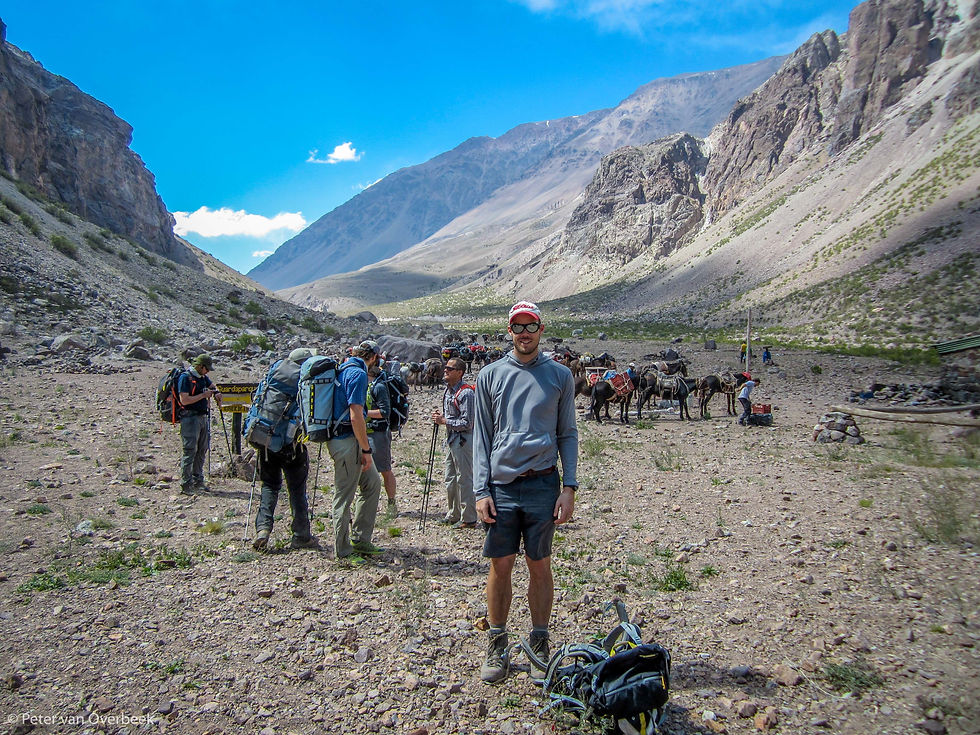
From Los Penitentes the trail to Aconcagua up the Vacas and Guanacos Valleys follows muddy mountain streams for about 25 miles, gradually gaining altitude and giving us an early opportunity to begin the acclimatization process. From the road it was a three day journey to basecamp on the eastern side of the mountain. The trek was was straightforward enough, made easier by the assistance of a large pack of mules we’d hired to ferry our bags and supplies along with us. Every couple hours a pack of heavily laden mules would trudge by, kicking up clouds of fine dust. Motivated by the whistle and whip of the Gauchos, I don’t wish it upon anyone to be reincarnated as a pack mule on Aconcagua. All things considered, the animals were treated quite well. But the Mule’s task was simply unenviable, and the rough terrain and heavy loads led to the occasional back country injury that forced them to be euthanized. Along our way to basecamp we’d encounter more than a couple mule skeletons, bleached pure white in the intense sun.
"It’s always an imposing feeling to behold your first glimpse of a mountain you plan to climb. Especially one as big as Aconcagua. Somehow it always seems bigger, more callous, and crueler than you imagined."
Our first day on the trail ended in the early evening at a large campsite with a huge boulder in the center, room enough for people and mules. Progress through the day had been steady and I was feeling quite good. Sweaty and a bit grimy already, but my months of training and preparation felt, for the time being, like I was up to the challenge. To my delight, the Gauchos brought out a handful of wine bottles and a heaping pile of grilled goat they’d been tending to in the hours leading to our arrival in camp. Miles from the nearest road and nestled into a beautiful mountain valley, the sun glowing red on the peaks above, this was the life.
After dinner our lead guide Peter gave the team our first real pep talk. We discussed the effects of Acute Mountain Sickness, heart attacks as a result of thickened blood, cerebral and pulmonary edema. All were dangerous and legitimate risks, not to mention that our cozy camp at 10,000 feet was by any normal standard at very high altitude.
The terrain changed little over the next two days as we progressed further up the Vacas Valley, the river our trusty guide to its mountainous source. The odd creek crossing and occasional Guanaco running in front of us broke up the days. It wasn’t until just before camp on the the second day that we got our first glimpse of the peak.
At the confluence of the Vacas Valley heading north and the Guanacos Valley to the east, there stood Aconcagua in full relief against the “lesser” 15,000+ foot peaks below. It’s always an imposing feeling to behold your first glimpse of a mountain you plan to climb. Especially one as big as Aconcagua. Somehow it always seems bigger, more callous, and crueler than you imagined. Maybe it’s some type of evolutionary response in your brain: are you sure this is such a good idea?
This time the experience was particularly nauseating as this was the largest mountain I had ever seen, and by a very wide margin. Aconcagua’s eastern and southern faces were framed perfectly by the Guanacos Valley that would lead us to basecamp and the mountain itself the next day. Storm clouds ripping off the summit, the peak was almost speaking to us: “Try me if you dare.” We’d finally met our objective, mystery no longer…Kimono open.

The walk to basecamp began early the next morning with the valley floor still in shadow. One of the most notable features of the approach to the mountain is the “opportunity” to jump a few creeks. The middle of the Valley was criss-crossed with ribbons of 5-10 foot wide gravel streams. Freezing cold (they were ice just hours before) and colored a cool grey-brown.
To jump or not to jump was the question of the morning. The first few streams out of camp were quite small and manageable with the whole team making swift hops to the far side of each successive stream. Eventually, however, we ran into what appeared to be the biggest stream of the morning and a few of the younger team members decided to risk a lengthy jump. We tossed our day packs across and committed to the leap. My jumping abilities are embarrassing at best, and my running start was quite a bit slower than desired in hiking boots and loose gravel. Leaving the ground I knew it was going to be a close call, but my jump was just good enough to land in shallow water on the far shore.
My dad was toying with the idea of jumping himself after seeing my feeble attempt. With visions of him taking an accidental dip in the cold stream I cautioned against it. A moments pause… and he made the right decision to take his boots off and properly forge the stream.
With these aquatic barriers behind us the trail climbed steadily up a set of dusty switchbacks. Gaining altitude quickly with the sun cresting the ridge-line behind us, it was hard and dusty work. At the top of this steep section we were rewarded with a fresh view of the mountain. A little closer than the day before and lit up brilliantly against a deep blue mid-morning sky. The wind was chasing down the mountain into our faces, but the spot proved to be a good one for taking pictures. It was pretty clear from my perspective that I wanted a photo with my finger on the summit. My dad was taking so long to frame the shot I figured he understood the plan and was trying to get it jussssttt right. Well, almost...

After a quick snack break the group continued to work our way up the final stretches of the Guanacos Valley to Basecamp. The last vestiges of life, grasses and lichens slowly faded away and the color green became no more. Crossing an ancient glacial lakebed, we crested the ridge of a tall moraine and an expansive outpost came into view. Here was basecamp at 13,000 feet in the remote backcountry of Argentina.


Comments